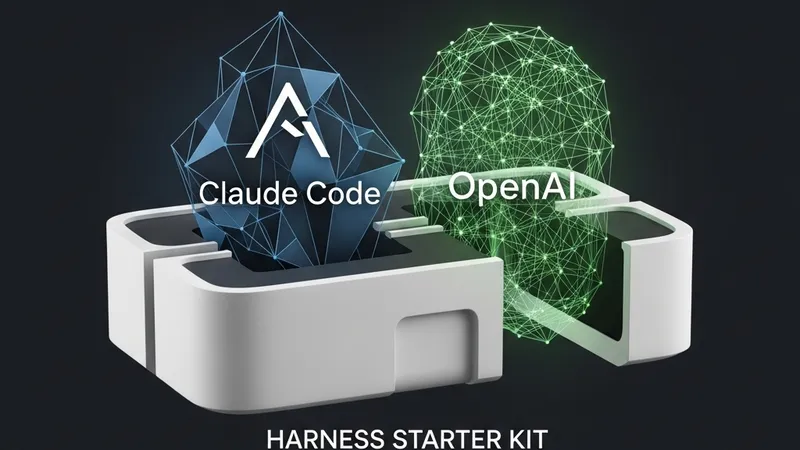
Continuous software delivery platform Harness has announced a major upgrade to its Starter Kit, introducing native support for Anthropic's Claude Code and OpenAI's Codex. This update is designed to help development teams rapidly integrate advanced AI coding agents into existing #DevOps workflows, bridging the gap between automated code generation and continuous integration/deployment (CI/CD).
Claude Code, the recently launched command-line tool by Anthropic, has gained massive traction for its ability to comprehend, write, and test code directly in the terminal. Through the #Harness Starter Kit, developers can bypass complex manual configurations of environment variables and permissions, executing Claude Code seamlessly within Harness pipelines. Concurrently, continued support for the established Codex model ensures enterprise users maintain flexibility in their multi-model strategies.
The core advantage of this integration lies in the "out-of-the-box" pipeline templates. While traditional AI coding tools are often confined to local IDEs, the Harness Starter Kit leverages standardized containers to extend AI agent capabilities to cloud build environments. This enables AI agents not only to write code, but also to execute unit tests and scan for security vulnerabilities within secure Harness CI sandboxes, iteratively refining code based on automated feedback.
[AgentUpdate Depth Analysis] Harness's integration of Claude Code represents a pivotal shift from IDE-bound AI assistance to automated, pipeline-level agentic workflows. While traditional Copilots rely heavily on real-time human prompts, integration with CI/CD platforms allows AI agents to operate within closed-loop execution and verification environments. Historically, integrating agentic workflows into enterprises faced massive friction around security and environment setup. By standardizing Claude Code and #Codex deployment via a declarative Starter Kit, Harness lowers the barrier to entry for production-grade Agentic DevOps. This sets a precedent where future software development cycles will likely evolve into fully autonomous pipelines, driving massive efficiency gains across the industry.