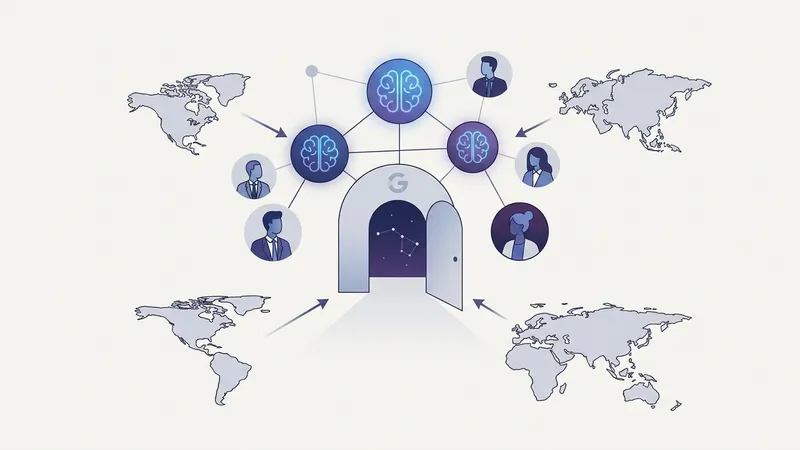
Google has officially announced an early access program for new features within its flagship Gemini AI model. This initiative invites AI developers and professionals worldwide to experience and collaboratively shape the next generation of Gemini's innovative capabilities. The key features targeted for this early testing phase are expected to include more robust multimodal understanding and generation, deeper contextual reasoning, and more flexible API integration.
Participants in the early access program will have the opportunity to be among the first to work with Gemini's refined ability to collaboratively process images, video, audio, and text. This includes capabilities such as extracting insights from complex datasets, generating creative content, and executing multi-step instructions across different modalities. Furthermore, Google may introduce new features optimized for enterprise applications, extending Gemini's potential in areas like Google Workspace collaboration, content creation, and code assistance.
This testing program is crucial for the continuous evolution of Google AI. By working closely with real-world developers, Google can gather invaluable practical feedback to optimize model performance, enhance user experience, and ensure the stability and security of new features. Interested teams and individuals can apply through the Google AI Developer Platform to gain priority access, collectively pushing the boundaries of AI technology.
[AgentUpdate Depth Analysis]
Google's early testing program for Gemini features marks a significant stride in its AI Agent strategy. The emphasis on enhanced multimodal capabilities means agents can perceive and understand the real world more holistically, moving beyond text-only interactions. An agent capable of understanding images and videos, for instance, could analyze user-submitted designs or product videos to provide more accurate feedback or recommendations. Compared to competitors like OpenAI's GPT-4V or Anthropic's Claude 3, Gemini's native multimodal design could offer superior coherence and efficiency in complex cross-modal tasks. For the AI Agent ecosystem, this implies that future agents will not only handle a broader range of task types but also interact with their environments through richer modalities, leading to more autonomous and intelligent applications such as smart assistants, automated content generation, or advanced data analysis agents. This capability race will accelerate the evolution of AI Agents from mere "conversational assistants" to truly actionable intelligent entities, driving their core role in enterprise applications and personal productivity tools.