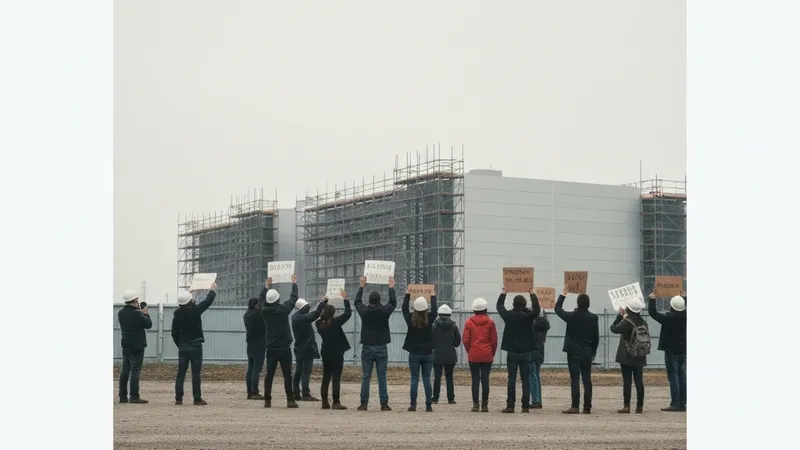
Opposition to data centers has reached an unprecedented scale, helping to block or delay projects worth an estimated $130 billion in the first quarter of 2026 alone. NBC News reported that from January to March, 75 projects were halted by opponents, citing data from Data Center Watch, an organization that tracks opposition to digital infrastructure.
The resistance has "consolidated into a national political force," #Data Center Watch stated, adding that the second half of 2025 marked a crucial turning point. "What began as individual zoning disputes is now reshaping elections, regulation, and site viability nationwide," the group observed, noting that this movement accelerated dramatically going into 2026.
"The quarter reflected a structural shift rather than a cyclical spike," the report detailed. "Communities have internalized an opposition playbook, legislative sessions introduced formal regulatory uncertainty, and the number of active opposition groups more than doubled to 833 across 49 states."
While data centers are absolutely critical to support big tech operations and AI development, public sentiment remains heavily hostile. A Gallup poll conducted in May revealed that 70 percent of Americans opposed the local construction of data centers, with 48 percent strongly opposing them. Environmental and resource concerns—particularly the excessive use of electricity and local water supplies—are the primary drivers of this backlash.
This public pressure is quickly translating into legislative barriers. NBC News reported that over 300 bills targeting data center regulation were introduced in state legislatures in just the first six weeks of 2026. In many instances, organized resistance was mobilized by mere rumors of a project before any official paperwork was filed.
[AgentUpdate Depth Analysis] The massive $130 billion infrastructure bottleneck highlights a fundamental physical constraint of the AI era: the friction between exponential compute demand and finite local resources. For the evolving AI Agent ecosystem, this roadblock will accelerate a structural shift away from massive, centralized cloud #inference toward hybrid, edge-based architectures. As localized physical compute becomes a scarce premium, agent developers must prioritize resource-efficient execution. This will drive innovation in model compression, local tinyML execution, and decentralized infrastructure (DePIN). Furthermore, orchestration frameworks will need to become "compute-aware," dynamically routing sub-tasks between edge devices and centralized clouds via protocols like MCP. In this resource-constrained reality, efficiency—rather than sheer scale—will define the next generation of AI Agent viability.