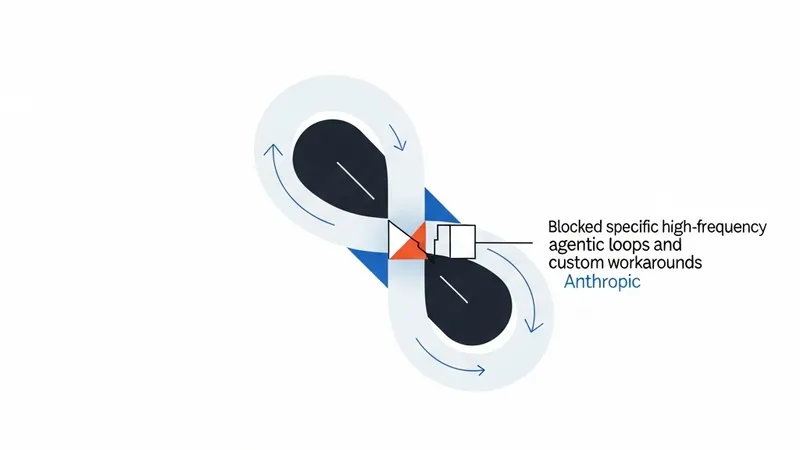
In the rapidly evolving landscape of autonomous systems, Anthropic has quietly throttled and blocked specific high-frequency agentic behaviors and unofficial middleware integrations, often referred to within developer circles as the 'Fable' patterns. This move highlights the rising friction between cloud-hosted LLM providers and autonomous agentic loops that execute high-frequency tool-calling sequences without human intervention.
An analysis of these quiet blocks reveals 11 critical technical details. First, the enforcement primarily targets recursive, high-velocity API calls initiated by Claude 3.5 Sonnet under suspicious orchestration frameworks. Second, #Anthropic has tightened constraints on the newly introduced Model Context Protocol (#MCP), executing strict schema validations to prevent prompt-injection workarounds. Custom system prompts designed to bypass standard safety guardrails are now being flagged and blocked automatically by real-time heuristic filters.
Looking ahead, Anthropic is preparing to roll out Claude 3.5 Opus, which will feature built-in, weight-level safety alignments rather than relying solely on wrapper-level filtering. Additionally, dynamic rate limiting will be introduced to favor certified, well-behaved Agent frameworks, while aggressively throttling unoptimized, high-loop scripts that clog their inference pipeline.
[AgentUpdate Depth Analysis] Anthropic’s tightening grip on agentic behaviors and the quiet blocking of Fable patterns highlight a pivotal transition in the AI Agent ecosystem from unregulated experimentation to structured governance. Compared to OpenAI's relatively permissive API approach, Anthropic prioritizes strict safety alignment and predictable execution boundaries. While these restrictions increase integration friction for developers of complex autonomous loops, they will ultimately accelerate the adoption of standardized communication protocols like MCP (Model Context Protocol). In the long run, this enforced optimization will drive the industry toward more efficient, deterministic agent architectures, shifting developer focus from brute-force prompt engineering to robust, event-driven workflow orchestration.