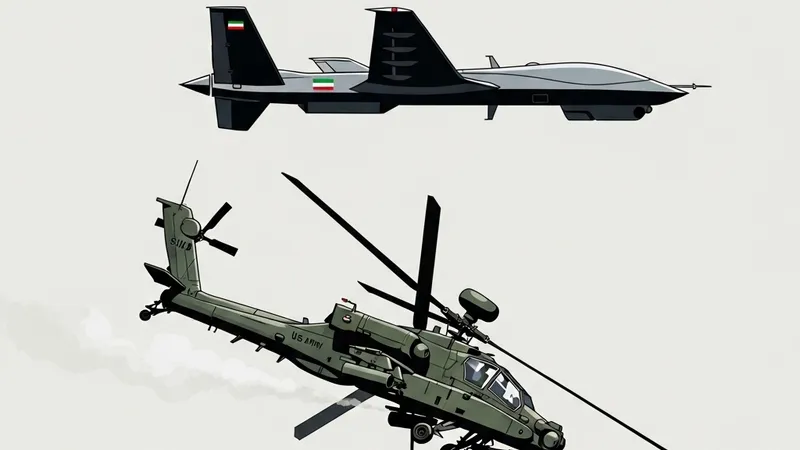
A US Army helicopter gunship was apparently struck by an Iranian Shahed drone before going down near the Strait of Hormuz. While US military investigators are still evaluating whether the June 8 midair collision was intentional or a lucky accident, the incident highlights a staggering asymmetric warfare capability. The crash was first reported by Axios correspondent Barak Ravid and later confirmed by The New York Times through anonymous US officials.
Since late February 2026, Iran has deployed thousands of Shahed #drones in the region. However, these basic models typically rely on GPS satellite guidance and preprogrammed coordinates, making them ideal for stationary targets like data centers or slow-moving ships rather than agile aircraft. Mark Cancian, a senior adviser with CSIS, noted that typical Shahed drones are not designed to track and strike moving targets. However, he suggested that Iran may have received newer Russian-modified Shahed drones that feature remote-control capabilities or upgraded autonomous edge tracking.
Regardless of the exact guidance mechanism, the economic contrast is stark: a drone costing approximately $35,000 managed to take down a highly sophisticated US Army AH-64 Apache helicopter valued at $25 million. The only silver lining for the US military was the successful rescue of the two-person helicopter crew from the water, made possible by the unprecedented deployment of a robotic drone boat.
[AgentUpdate Depth Analysis] This incident underscores a critical inflection point in the shift from centralized, capital-intensive platforms to decentralized, low-cost "embodied AI agents" operating at the tactical edge. The asymmetric dynamic—where a $35k drone neutralizes a $25m helicopter—mirrors the evolutionary trajectory of the wider AI Agent ecosystem. Instead of relying on monolithic, hyper-expensive computing architectures, the future belongs to autonomous, distributed agent swarms equipped with lightweight computer vision and localized decision-making. As AI Agents transition from digital sandboxes to physical robotics and drone swarms, their ability to execute complex, real-time reactive tasks collectively will redefine both physical security and industrial automation. The core takeaway is clear: scalable swarm intelligence will consistently outmaneuver rigid, centralized legacy systems.