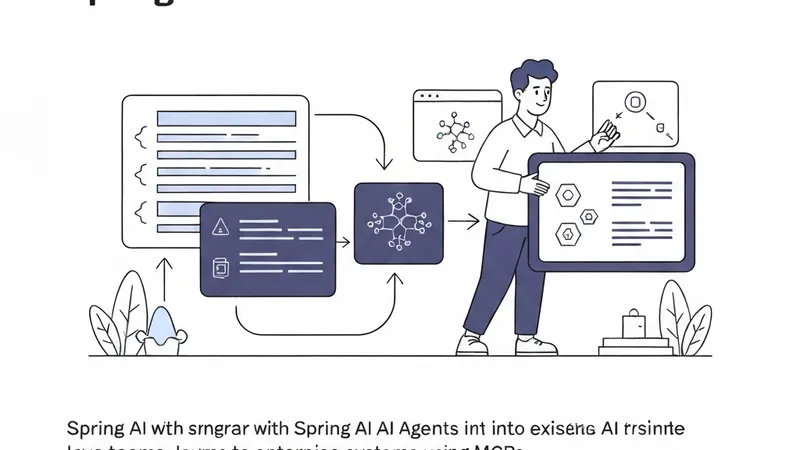
MCP (Multi-tool Coordination Protocol) becomes particularly relevant when connecting AI agents to existing systems within enterprise applications. For Java development teams, Spring AI offers a practical pathway to build this crucial bridge.
Why Build an MCP Server?
An MCP server exposes tools or data sources to AI clients through a shared protocol. This approach avoids directly wiring every AI client into your application, instead providing a controlled integration layer. The conceptual flow is: AI client -> MCP server -> application logic or data source. This layer is instrumental in enforcing boundaries, validating inputs, and ensuring explicit tool behavior.
The Fit for Spring AI
Spring teams already have well-established patterns for dependency injection, configuration, security, observability, REST APIs, database access, and testing. For organizations heavily invested in Java and Spring Boot, building AI tool integrations within this familiar ecosystem generally proves easier to operate and maintain compared to adopting a separate, experimental stack.
Example Use Cases
A Spring-based MCP server can expose a variety of tools, such as searching internal documentation, looking up customer records, fetching release information, creating a support ticket, summarizing incident data, or validating a business rule. The critical principle here is that each exposed tool should serve a narrow and well-defined purpose.
Keep Tools Small
An example of a 'bad' tool might be a monolithic doEverythingForCustomer() function. More effective tools are granular and focused, such as findCustomerById(), listOpenTickets(), createFollowUpTask(), or summarizeAccountHistory(). Smaller tools inherently offer benefits in terms of ease of testing, logging, and restriction.
Security Concerns
An MCP server functions as a powerful gateway, thus it must be treated with the same rigor as critical backend infrastructure. Key security considerations include: authentication, authorization specific to each tool, differentiation between read-only and write actions, comprehensive audit logs, robust input validation, rate limits, secure secrets management, and controlled access to production data. It is imperative not to expose potentially dangerous internal operations, even if the AI model might hypothetically use them 'correctly'.
Testing Matters
The behavior of each tool must be testable independently of the AI model. For every tool, thorough checks should cover: valid input scenarios, invalid input scenarios, permission failures, cases yielding empty results, and potential downstream service errors. While an AI client's behavior can be probabilistic, the tool's boundary should always be deterministic.
Bottom Line
The combination of Spring AI and MCP offers a highly effective solution for teams aiming to enable AI agents to interact with real backend systems, moving beyond one-off integration scripts. The primary value extends beyond merely 'AI calling Java'; it lies in establishing a maintainable, secure, and explicit boundary between AI agents and core business systems.