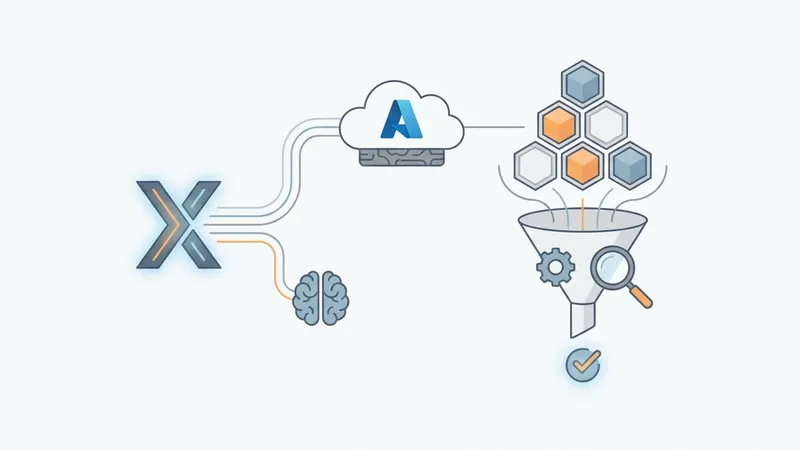
At a critical inflection point for Agentic AI, a striking dataset demonstrates the power of enterprise Agent implementation: AI code coverage exceeding 70%, over 700 internally created Skills, 400+ API endpoints connected, and 140,000+ completed workflows with zero P0/P1 defects. This is the reality for XPeng Motors. By utilizing AWS services such as Kiro, Amazon Bedrock, and Amazon EKS, XPeng has built 'Lingxi', an internal AI programming and Agentic work platform.
He Ruibang, Head of XPeng's AI/Data Platform, noted that while individual developer efficiency soared in 2024, overall department throughput stagnated. In cyber-physical systems like smart vehicles, hardware-software binding is tight, making code generation only one small step in a long chain of compilation and physical testing. To overcome this, XPeng transformed AI coding into an autonomous engineering team. In SRE operations, XPeng deployed four SRE Agents on Amazon Bedrock with 5D attribution, shrinking auto-remediation time from two days to 10 minutes.
Lingxi's five-layer architecture features a developer portal, an Agent collaboration layer driven by Kiro, a data/knowledge layer, a model layer powered by Amazon Bedrock, and an infrastructure layer on Amazon EKS. Crucially, it relies on 'Spec-Driven Development', structuring requirements and tests before AI generates code, minimizing technical debt by securing correctness at the source.
In addition to automotive, LLM unicorn Moonshot AI (Kimi) showcased its global expansion via #AWS. Aiming for the optimal conversion of energy to intelligence, Kimi focuses on token efficiency, long contexts, and multi-agent coordination, recently launching K2.7 Code High-Speed version yielding 180 tokens/sec.
Kimi is deepening its collaboration with AWS: scaling on global infrastructure, integrating with Amazon SageMaker for simplified model training and deployment, listing on the AWS Marketplace, and preparing for native integration into Amazon Bedrock to target global enterprise customers across finance, healthcare, and manufacturing.
[AgentUpdate Depth Analysis] The shift from simple "Copilot" assistants to highly autonomous "Agentic Workforces" is the defining trend of 2026. XPeng's "Lingxi" platform, built on Amazon Bedrock and Amazon EKS, directly addresses the "efficiency vs. effectiveness" paradox. While standard LLM coding tools speed up draft writing, they often accumulate technical debt for human developers to debug. By leveraging Kiro's spec-driven architecture and multi-agent coordination, XPeng closes the software delivery loop—slashing bug remediation from days to minutes. Compared to consumer-grade tools like Cursor, this enterprise-grade deployment proves that the ultimate value of AI Agents lies in orchestrating complex, end-to-end workflows within scalable cloud environments. For the global AI Agent ecosystem, this signals that the future battlefield is moving from isolated model performance to deep, cloud-native workflow integration.