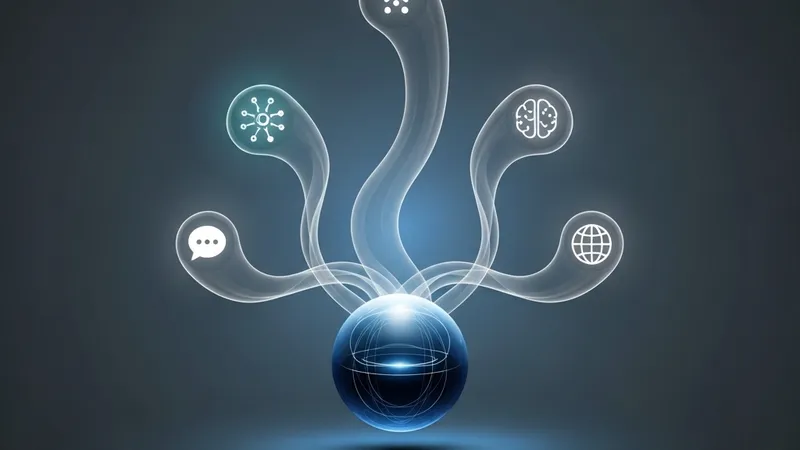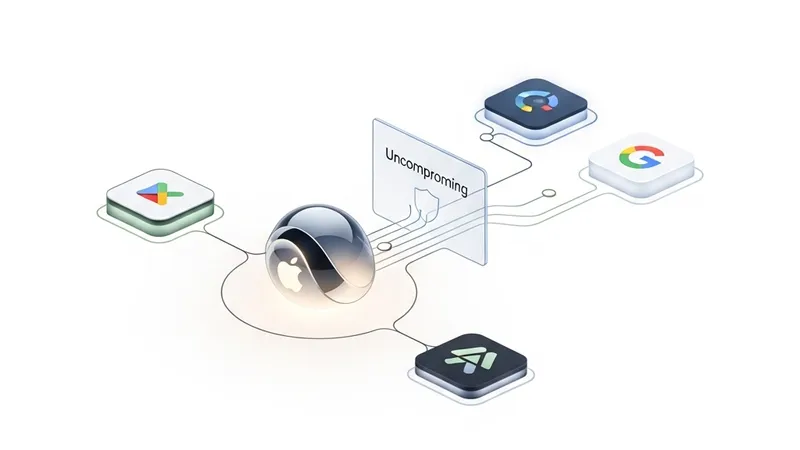
Apple executive Craig Federighi outlined the high-level architecture of the new Apple Intelligence capabilities. Standing before the audience, Federighi explicitly stated that Apple uses absolutely none of the Google Assistant. He contrasted Apple's approach with traditional chatbot architectures, where a local client app communicates with cloud-based models running on third-party servers, which then tap into services like Google Search for global knowledge.
Apple's system heavily relies on on-device models for simpler queries. With this year’s OS releases, most Apple Intelligence devices will feature AFM 3 Core, a new model co-developed by Google and Apple based on Gemini. Newer devices equipped with at least 12GB of RAM and recent chips will utilize AFM 3 Core Advanced. This enhanced model leverages extra hardware power and device storage to significantly improve dictation and drive a much more expressive Siri voice.
For more sophisticated inquiries, the device will seamlessly contact cloud-based models that are also co-developed by Apple and Google. These include a general-use model called AFM 3 Cloud, an image-generation model named ADM 3 Cloud, and an advanced tier known as AFM 3 Cloud Pro, optimized specifically for agentic tool use and complex reasoning. According to Apple, the first two models run on Apple's custom silicon within its own servers, whereas the Cloud Pro model operates on Nvidia hardware owned by Google.
To maintain its rigorous privacy promises while utilizing external infrastructure, Apple has introduced a fresh iteration of Private Cloud Compute (#PCC) engineered specifically for third-party hardware. Apple is integrating Nvidia's Confidential Computing, Intel's Trust Domain Extensions, and Google's Titan security chip to construct layers of protection identical to its proprietary servers. For enhanced security, Apple maintains a cryptographically verifiable, append-only ledger of all Google Cloud hardware in the PCC fleet, ensuring that user devices only trust software carrying an official Apple cryptographic signature.
[AgentUpdate Depth Analysis] Apple's revelation of its hybrid cloud architecture marks a monumental breakthrough in privacy computing and sets a visionary precedent for the rapidly evolving AI Agent ecosystem. Historically, cloud-edge collaborative architectures force an inevitable trade-off between immense reasoning power and sensitive data privacy. By deploying its upgraded Private Cloud Compute (PCC) across external hardware like Nvidia and Google, Apple masterfully dismantles the assumption that outsourcing computation compromises user security. More crucially, dedicating the AFM 3 Cloud Pro model explicitly to agentic tool use and complex reasoning signifies Apple's deliberate and powerful pivot toward fully autonomous agents. Compared to current popular frameworks such as LangChain or CrewAI, which often face immense trust barriers when handling sensitive multistep execution tasks, Apple’s implementation of hardware-level secure enclaves establishes a foolproof blueprint for enterprise-grade Agent deployment. In the future, robust AI agents will rely on instant local perception seamlessly combined with securely verified massive cloud inference, propelling the entire industry toward friction-less, cryptographically secure distributed agent networks.