In just a few days, we will be standing at the venue of WWDC 2026. This year's developers conference shifts its focus back to AI, which not only defines the current iPhone but also shapes unreleased hardware, such as Apple's highly anticipated #smart glasses.
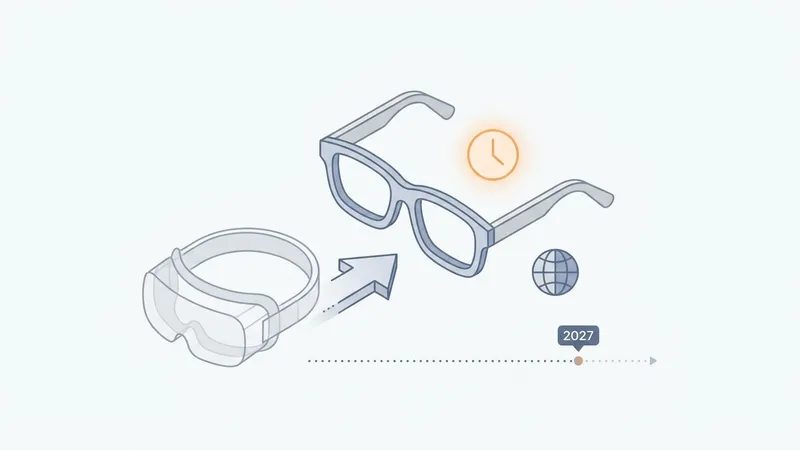
The latest reports indicate that these smart glasses, codenamed N50, have been delayed. According to Bloomberg's Mark Gurman, the launch has been pushed from late 2026 to late 2027. Despite the delay, the product logic is becoming clearer: they resemble Ray-Ban Meta rather than the heavy Vision Pro, mirroring the evolutionary business strategy of the Apple Watch.
Apple's first-generation glasses will likely not be full-fledged AR glasses. Leaks suggest they will feature cameras, microphones, and speakers, deeply integrated with #Siri and Apple Intelligence. The core keywords are "perception" and "feedback," allowing users to query objects they see without pulling out their phones. While the iPhone handles core computing and data processing, the glasses serve as a sensory extension.
This matches Google's Intelligent Eyewear strategy, which divides eyewear into audio-only, light-display, full AR, and Android XR headsets. Apple is pursuing a similar tiered roadmap, with N50 positioned as the lightweight, screen-less entry level focused on daily synergy.
Market data supports this shift. According to IDC, global smart glasses shipments reached 14.77 million units in 2025, a 44.2% year-on-year increase, with display-less models driving the growth. Meanwhile, Omdia forecasts that AI glasses shipments will exceed 10 million in 2026 and hit 35 million by 2030, proving that lightweight, screen-less designs are the primary path to mainstream adoption.
As noted by Xu Chi, founder of AR manufacturer XREAL, future eyewear will diverge into daily lightweight AI glasses, portable displays, and heavy MR headsets like Vision Pro. The N50 represents the lightest, most wearable tier in Apple's ecosystem.
This resembles the trajectory of the Apple Watch. The original Watch tried to do everything—luxury, social, health—even launching a $17,000 Gold Edition. Only after generations of "subtraction" did it find its footing in fitness and health. Apple's glasses prioritize establishing a "real-world gateway" over complex displays. This is why Tim Cook and potential successor John Ternus are strongly championing this project.
In contrast, the $3,499 Vision Pro represents additive design without compromise, leading to weight and battery constraints. Apple's glasses represent bold subtraction: proving the value of a facial portal integrated with Multimodal AI before adding complex optics, showcasing Apple's signature playbook of refining a category at its inflection point.
[AgentUpdate Depth Analysis] Apple's decision to strip the N50 of a display and focus on "screen-less perception" points to a critical hardware evolution for the AI Agent ecosystem: transitioning from "screen UI" to "environmental awareness." Traditional AI Agents are often confined within desktops or mobile apps, suffering from a lack of real-time environmental context. Smart glasses, acting as a facial portal, equip Agents with eyes and ears to capture continuous, first-person multimodal inputs. Compared to the heavy, expensive spatial computing of Vision Pro, display-less AI glasses achieve physical agent presence with minimal weight and power. This strategic shift moves the center of gravity from "display rendering" to "multimodal intent understanding." By offloading heavy compute to the iPhone, Apple is building a distributed agent ecosystem where Apple Intelligence serves as the brain, the glasses as the sensor, and the iPhone as the processor—offering the most viable paradigm for AI Agents to integrate into daily human life.