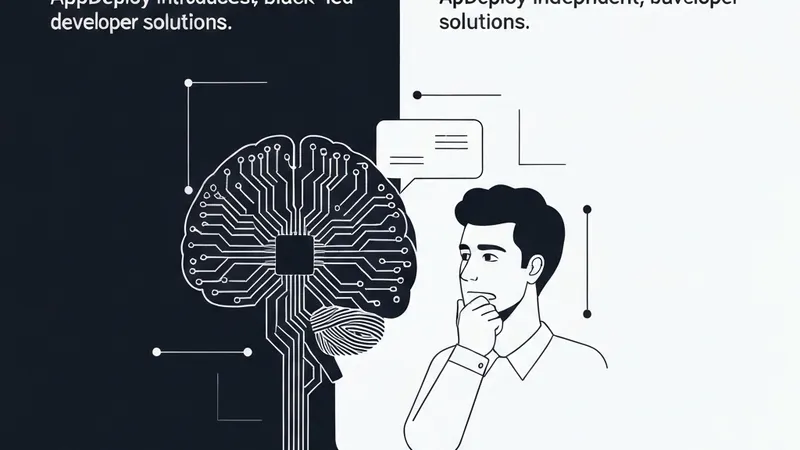
When artificial intelligence (AI) generates code, relying on the same AI to validate its functionality is inherently problematic. To address this, AppDeploy has developed an independent, black-box QA agent. This agent interacts with every deployed application precisely as a real user would—clicking, navigating, and verifying outcomes. Designed for speed and cost-efficiency, it runs automatically after every deployment. This process is termed autonomous end-to-end QA: a black-box testing methodology executed post-deployment that delivers QA snapshots, visual bug reports, and detailed logs directly back into the development chat environment.
Historically, trust in code stemmed from human ownership. A developer wrote it, reviewed it, and could articulate its functionality. AI-built applications, often referred to as "vibe coding," challenge this premise. Features can be shipped following minimal prompts and automated diffs, making it difficult for anyone to fully comprehend every line of recent changes. Consequently, QA emerges as the definitive source of truth, offering automated and continuous proof that the system continues to operate correctly.
This principle is particularly critical within chat-native deployment platforms like AppDeploy. Every time an application is deployed via AppDeploy, once the build process completes, a dedicated QA agent automatically executes a comprehensive test suite to verify the application's quality.
AppDeploy's methodology integrates a test-driven development (TDD) approach, where application functionality is defined by tests prior to implementation. The coding agent first generates these tests, then proceeds to implement the application until the entire test suite passes. Should the agent identify any bugs, AppDeploy provides structured feedback, including a detailed description of each failure, a relevant screenshot, and any browser console errors. The coding agent then utilizes this feedback to resolve the issues and triggers AppDeploy for a redeployment. The QA process automatically reruns, and this iterative cycle continues until all tests are successfully passed.
The entire development and testing loop can be summarized as follows: you provide a prompt, a coding agent builds the application, AppDeploy deploys it, a QA agent conducts end-to-end tests on the deployed application, results are fed back into the chat, and the agent then fixes issues and redeploys the application.
How then, does one effectively QA AI-built applications? True confidence cannot be achieved by simply instructing the same agent that built the code to run a single Playwright script. When the builder and the checker operate under identical assumptions, the outcome is agreement, not genuine assurance. Authentic QA necessitates independent validation that the system functions correctly in its live operating environment, across critical workflows, with its actual dependencies, and under various potential failure modes. The ultimate goal is to transition from merely "it looks right" to "it is proven."
The tasks of writing code and verifying code are fundamentally distinct. While a coding agent excels at rapidly generating plausible implementations, verification demands an independent standard of truth and a willingness to identify and flag changes that fail. When a single agent serves as both builder and judge, the inherent incentives and potential failure modes become misaligned. This "same brain problem" implies that shared assumptions between the builder and checker prevent the delivery of truly independent assurance.