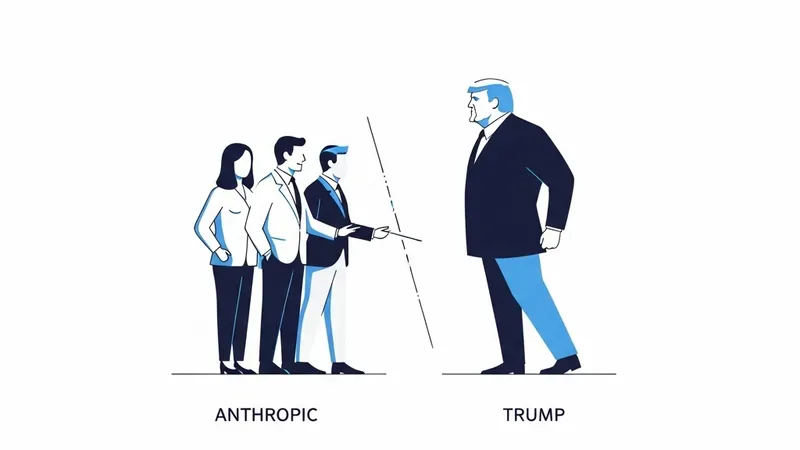
According to Axios, senior executives from Anthropic are working to reach an agreement with the Trump Administration in Washington, D.C., following a White House order that forced the company's flagship models offline. On Friday, #Anthropic disabled its advanced AI models after a federal export control order prohibited non-U.S. nationals from accessing them. The affected models include Claude Fable 5 and Claude Mythos 5.
These disabled models are "Mythos-class" systems, built on the same core technology as Claude Mythos Preview, which Anthropic announced in April but withheld from public release due to extreme risks regarding global cybersecurity and abuse. Fable 5 and Mythos 5 were designed as heavily guarded, "tamed" versions of that original model, made available to paid #Claude subscribers briefly from Tuesday to Friday.
The catalyst for the sudden takedowns involves Amazon and five other tech companies, which demonstrated potential "jailbreak" exploits to the White House on Thursday and Friday. Furthermore, reports from Semafor indicated White House anxiety over a "China-linked group" allegedly gaining access to a Mythos-class model, despite Anthropic's geo-blocking policies.
On Friday afternoon, Anthropic received a White House call stating that keeping these models online posed a "national security threat," giving the startup a strict 90-minute deadline to disable them. This was followed by a formal export control letter. Sources suggest the Trump administration remains unsatisfied with Anthropic's response, accusing them of not engaging in a serious manner. Ironically, Sunday marked President Trump’s 80th birthday, coinciding with a scheduled UFC match staged on the White House lawn, even as Anthropic's leaders faced critical negotiations.
[AgentUpdate Depth Analysis] The forced shutdown of Anthropic's Mythos-class models represents a critical turning point where AI safety, cybersecurity, and national policy collide. Technically, the vulnerability of Fable 5 proves that relying on outer-loop guardrails is insufficient to fully secure high-capability models against sophisticated jailbreaks. For the AI Agent ecosystem, where agents are increasingly granted autonomous tool-execution and network access, model-level intrinsic safety is paramount. This unprecedented 90-minute federal intervention signals a shift toward proactive, hardline state intervention. Going forward, developers building enterprise-grade agentic workflows must anticipate stricter regulatory friction. To mitigate systemic risks, the AI ecosystem should shift toward hybrid, multi-model orchestrations and local private deployments, reducing single-point dependencies on highly scrutinized frontier API models.