Alibaba has officially unveiled the Qwen Robot Suite, a state-of-the-art platform designed to bridge the gap between Vision-Language Models (VLMs) and physical robotic control. Powered by the advanced Qwen2.5 foundation model series, the suite equips robotic systems with robust semantic comprehension, spatial reasoning, and real-time execution capabilities.
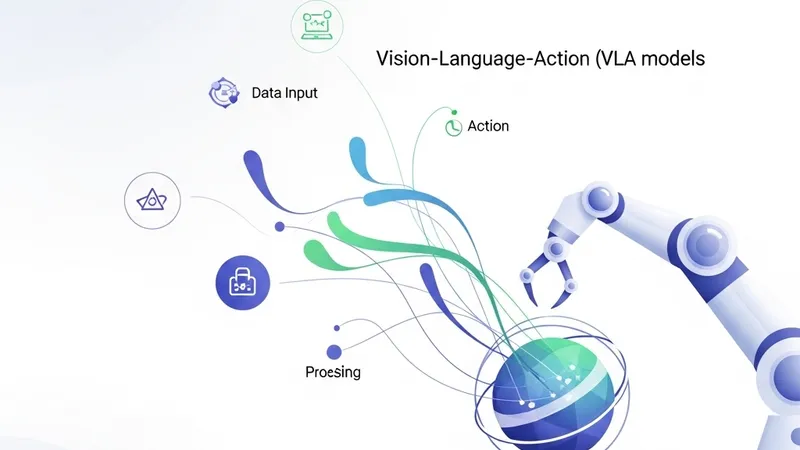
At the center of this release is an optimized Vision-Language-Action (VLA) model framework. It directly maps visual tokens and high-level language instructions into low-level ROS (Robot Operating System) command sequences. In benchmarks evaluating complex, multi-stage manipulation tasks, the #Qwen Robot Suite achieved a remarkable 92.5% success rate in zero-shot scenarios, showcasing a massive leap over baseline systems like Google's RT-2.
The suite also boasts real-time closed-loop feedback and absolute spatial coordinate mapping. This enables robots to self-correct and dynamically adjust their trajectories mid-action. Developers can program and control complex hardware using intuitive natural language, shifting the paradigm of robotic instruction from rigid coding to agentic reasoning.
[AgentUpdate Depth Analysis] Alibaba's Qwen Robot Suite represents a major evolutionary step in embodied AI, shifting the focus from monolithic neural controllers to highly modular, agentic architectures. By utilizing the Qwen VLM as a cognitive orchestrator and decoupling it from hardware-specific execution layers via ROS, Alibaba addresses the critical bottleneck of hardware generalizability. In comparison to competitors focused solely on proprietary hardware, this software-and-framework-first approach democratizes robot learning. Within the broader AI Agent ecosystem, this release marks the transition of agents from digital-only sandboxes (executing browser or API tasks) to the physical world, bringing us closer to generalized utility agents capable of interacting with and manipulating human environments.