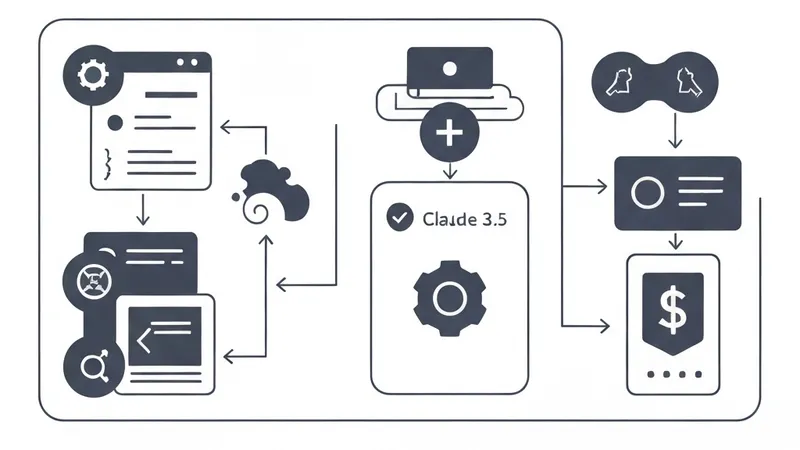
The artificial intelligence landscape is undergoing an unprecedented 'major version bump.' At the epicenter of this shift, Anthropic has unveiled its upgraded Claude 3.5 Sonnet, introducing a groundbreaking feature known as 'Computer Use.' This capability enables AI Agents to interact with computer software just like humans do—by perceiving screens, moving cursors, clicking buttons, and typing text. This breakthrough marks a definitive transition for AI from simple 'conversational assistants' to autonomous 'doers' capable of executing complex, end-to-end workflows.
Beyond software breakthroughs, massive capital is aggressively flowing into AI infrastructure. Tech giants including Microsoft, Google, and Amazon have disclosed a combined annual capital expenditure exceeding $150 billion in their latest earnings, primarily dedicated to building next-generation data centers, acquiring NVIDIA B200 GPUs, and securing clean energy. This convergence of agentic capability leaps and massive capital injection makes the prediction of achieving AGI by 2026 increasingly plausible.
On the enterprise application front, the upgraded Claude 3.5 Haiku is equally formidable. While maintaining strict cost-efficiency, it outperforms the previous-generation flagship #Claude 3 Opus on multiple agentic task benchmarks. This rapid pace of high-performance, cost-effective model iterations is forcing startups and developers to completely rethink their technology stacks, as thin wrappers risk being instantly sherlocked by native LLM capabilities.
[AgentUpdate Depth Analysis] #Anthropic’s 'Computer Use' coupled with unprecedented industry capital infusion signifies that the AI Agent ecosystem is shifting from API-bound pipeline integrations to visual-based, universal system interactions. Traditional Agent frameworks, such as LangChain or CrewAI, typically require developers to write tedious API adapters for each target software. Conversely, the 'Computer Use' paradigm offers a unified GUI manipulation standard, allowing agents to seamlessly leverage millions of legacy software systems designed for humans. In the short term, this will disrupt traditional RPA players; in the long term, it drastically expands the operating horizon of enterprise agents. As hundreds of billions of dollars in infrastructure mature and compute costs decrease, high-frequency, multimodal agentic decision-making will become economically viable, accelerating the arrival of a truly autonomous agent-driven economy.