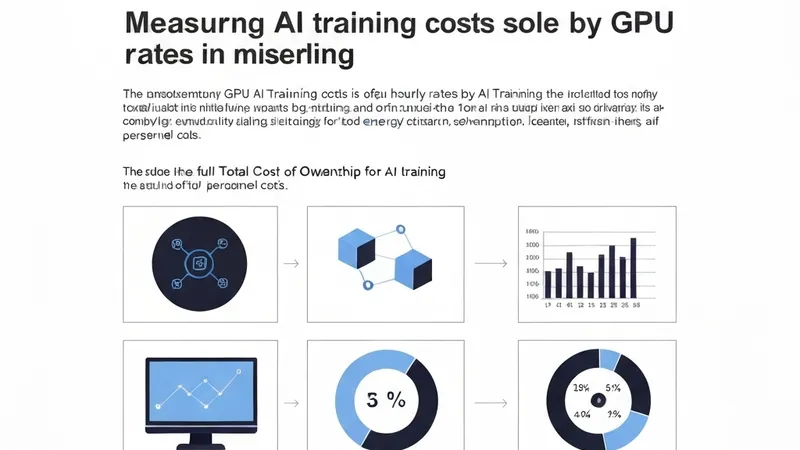
The cost of training today's large-scale foundation models is often reduced to a single number: the price of a GPU hour. While a convenient metric, it is often the wrong one. With training runs potentially costing tens or even hundreds of millions of dollars, operating AI at scale demands a deeper understanding of the underlying economics.
Given that cloud providers offer everything from bare metal servers to highly optimized infrastructures, comparing hourly pricing is rarely straightforward, and hidden costs can quickly inflate total spend. The real question isn't merely how much a GPU hour costs, but rather how many GPU hours it actually takes to complete a training run. This is what ultimately determines the Total Cost of Ownership (TCO).
Why Booked GPU Hours Don't Equal Useful Training Time
Large-scale AI training workloads rely on parallel computing, where multiple nodes are interconnected in a GPU cluster, distributing tasks to thousands of GPUs. The larger and more complex the cluster, the greater the risk for failures and operational inefficiencies. Every interruption on the cluster carries a direct financial cost. For instance, a 3,000-GPU cluster operating at $2 per hour per chip costs $6,000 per hour to run. Two hours of downtime adds $12,000 to the training bill. Across a multi-week training run, even small differences in downtime can have a profound impact on overall cost.
This illustrates why GPU hours can be misleading: while all clusters experience some idle time, the extent varies significantly. The useful compute time delivered by reserved GPU hours largely depends on the provider's infrastructure efficiency.
Here's where the discrepancies between reserved GPU hours and effective training time originate:
GPU utilization is not 100 percent: When running real-world workloads, GPUs often deliver lower performance than the benchmarks listed in their hardware specifications. Large clusters of interconnected servers can suffer from poor node coordination, operational friction, and communication failures that negatively affect performance. In most cases, GPU usage is around 95-97 percent of expected performance, or even lower. However, providers with sophisticated AI infrastructure optimize their networks and software layers to achieve better utilization of the GPU's potential, sometimes reaching up to 102 percent of anticipated usage. This difference can significantly accelerate training.
Checkpointing: Most machine learning teams use checkpointing to enhance resilience. By saving the progress of training jobs at set intervals, teams can resume training after interruptions without having to start from scratch. However, pausing to save checkpoints introduces measurable overhead. At a typical team's cadence of checkpointing every three hours, even short five-minute pauses accumulate to roughly 40 minutes of lost time over a 24-hour period. Infrastructure that provides high-speed storage can help mitigate some of this lost time.
Job interruptions: Both planned and unplanned interruptions are common in large AI clusters.