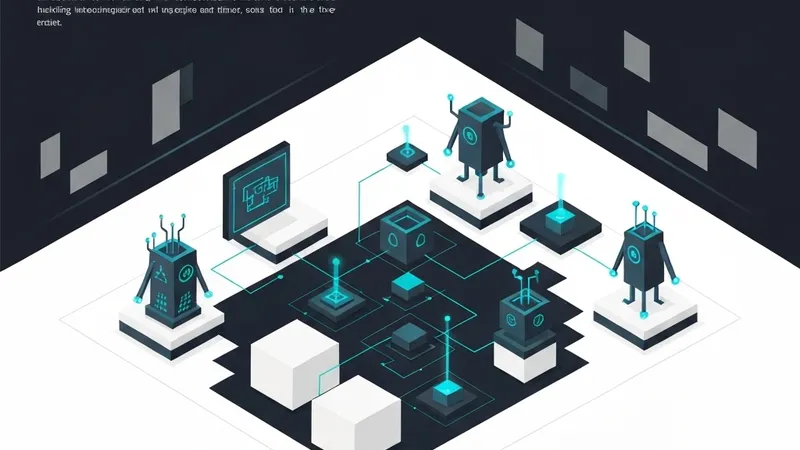
AI agents are increasingly populating corporate networks, autonomously reasoning through tasks and executing decisions. However, when these independent actors attempt to coordinate work, exchange context, or operate across varied cloud environments, the existing interaction framework quickly degrades. This forces human operators to become the 'manual glue' between disconnected systems, managing fragile integrations while crucial permissions and data sharing rules remain implicit, leading to significant automation waste.
To address this critical infrastructure problem, Tel Aviv and San Francisco-based startup Band has emerged from stealth mode, announcing a $17 million seed funding round. The funding will support CEO Arick Goomanovsky and CTO Vlad Luzin in their mission to build a dedicated interaction layer for autonomous corporate systems. This concept parallels previous evolutions in computing, where application programming interfaces (APIs) necessitated dedicated gateways, and microservices required a service mesh to function effectively at scale.
As distributed systems proliferate under the ownership of diverse internal teams, merely adding more business logic fails to resolve the underlying instability. Instead, ensuring interaction reliability mandates a distinct infrastructure layer.
Market dynamics have shifted in three key ways. Firstly, autonomous actors have transitioned from experimental deployments to active runtime participants, managing critical functions like engineering pipelines, customer support queries, and security operations. Enterprise usage is no longer a future prospect; it is an active operational reality. The pressing challenge now is how to effectively manage these distinct actors when they must collaborate.
Secondly, the operational environment is entirely heterogeneous. Engineering teams develop disparate tools across various frameworks, with models executing on competing cloud platforms, utilizing diverse communication protocols, and reporting to separate business owners. No single vendor maintains overarching control, and no uniform framework encapsulates the entire ecosystem. This fragmentation represents the permanent state of the enterprise market.
Thirdly, a foundational standards layer is beginning to take shape. Initiatives such as the Model Context Protocol (MCP) provide models with a uniform method for accessing external tools. Similarly, Agent-to-Agent (A2A) communications efforts are establishing baseline conversational parameters. However, while these protocols define the 'handshake,' they fall short of managing the full production environment. Standardized protocols do not administer routing, error recovery, authority boundaries, human oversight, or runtime governance. They cannot manifest the shared operational space essential for reliable interaction. Band aims to fill this critical infrastructure void.
Deploying independent models across business units creates compounding integration challenges. If point-to-point integrations must be hand-wired by internal development teams, the financial and operational burden becomes immense.