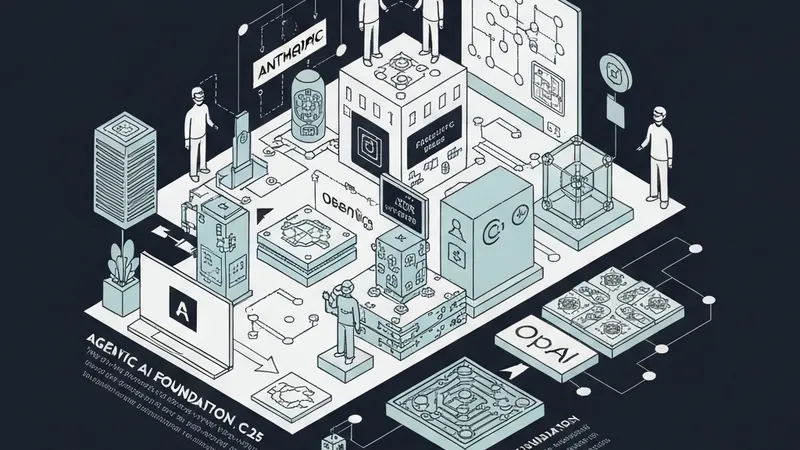
In December 2025, a significant development reshaped the competitive landscape of artificial intelligence. Anthropic, OpenAI, Google, Microsoft, and a host of other tech giants announced their collaboration under the Linux Foundation to establish the Agentic AI Foundation. This initiative aims to consolidate three previously competing protocols—Anthropic's Model Context Protocol (MCP), Block's Goose agent framework, and OpenAI's AGENTS.md convention—into a unified, neutral consortium.
After years of proprietary battles, the industry appears to be converging on shared infrastructure, paving the way for the era of autonomous software agents. The timing of this convergence is particularly noteworthy. According to the Linux Foundation's announcement, MCP server downloads surged from approximately 100,000 in November 2024 to over 8 million by April 2025. The ecosystem now boasts more than 5,800 MCP servers and 300 MCP clients, with significant deployments at Block, Bloomberg, Amazon, and hundreds of Fortune 500 companies. RedMonk analysts have likened MCP's adoption curve to Docker's rapid market saturation, identifying it as the fastest standard uptake the firm has ever observed.
However, beneath this apparent unity lies a critical question that few in the industry are willing to directly address: What are the consequences of standardizing the underlying "plumbing" before fully understanding the nature of the "flow" that will traverse it? What if the orchestration patterns being solidified into protocol specifications today prove fundamentally misaligned with the advanced reasoning capabilities that are expected to emerge tomorrow?
Technological history is replete with standards that, while seemingly crucial at their inception, later constrained innovation in ways unforeseen by their creators. Examples such as the OSI networking model and the Ada programming language illustrate how premature consensus can inadvertently lock entire ecosystems into architectural choices that subsequently prove suboptimal. A University of Michigan analysis highlighted that while standardization enhances technological efficiency, it can also excessively prolong existing technologies by inhibiting investments in novel developments.
The stakes in the agentic AI standardization race are considerably higher than those of previous technology transitions. We are not merely establishing how software components communicate; we are potentially defining the architectural assumptions that will govern how artificial intelligence decomposes problems, executes autonomous tasks, and integrates with human workflows for decades to come.
To grasp the industry's urgency toward standardization, one must understand the economic pressures that have made fragmented agentic infrastructure increasingly unsustainable. The current situation mirrors the early days of mobile computing, where each manufacturer implemented its unique charging connector and data protocol, presenting a significant hurdle for developers.