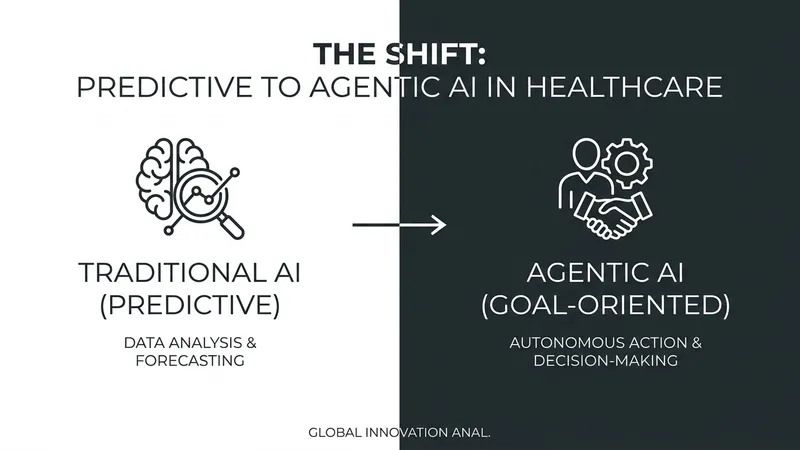
In the healthcare sector, the evolution of Artificial Intelligence is reaching a pivotal turning point. Traditional AI models, such as deep learning for medical imaging or regression-based risk scoring, have long served as specialized 'diagnostic aids.' However, with the maturation of Large Language Models (LLMs), Agentic AI is emerging, bringing unprecedented autonomy and multi-step reasoning to clinical workflows.
Traditional AI is inherently reactive. For instance, when a clinician uploads an X-ray, the model outputs an anomaly score. In this paradigm, AI is a static tool with boundaries limited to feature extraction and classification. Conversely, Agentic AI possesses a reasoning-action loop. A healthcare agent can not only identify an abnormal lab result but also autonomously cross-reference the patient’s medical history in the Electronic Health Record (EHR), and even draft a specialist referral or suggest medication adjustments for physician approval.
The fundamental technical distinction lies in goal-orientation and tool-use. Agentic AI leverages frameworks like ReAct (Reasoning and Acting) and Chain-of-Thought to decompose complex healthcare tasks into executable sub-tasks. It doesn't just process text; it interacts with external APIs, such as laboratory systems and insurance portals, to achieve high-level objectives. This shift marks the transition of AI from a passive 'knowledge base' to a context-aware 'virtual clinical associate' capable of strategic planning.
In practical scenarios, while traditional AI excels at predicting readmission risks or segmenting tumors, Agentic AI can manage the entire patient care lifecycle. It can automatically adjust post-operative follow-up schedules based on real-time monitoring data, conduct natural language check-ins with patients to confirm medication adherence, and dynamically update care plans based on patient feedback. This end-to-end automation is a critical technological path toward solving global healthcare staffing shortages and clinician burnout.
Despite its vast potential, the implementation of Agentic AI in healthcare faces rigorous challenges regarding safety, explainability, and compliance. Unlike the deterministic inputs/outputs of traditional AI, the decision-making pathways of Agentic AI are more complex, necessitating robust 'Human-in-the-Loop' mechanisms. Future medical systems will likely feature a deep integration of predictive Traditional AI and proactive Agentic AI to build a more resilient and efficient smart healthcare infrastructure.